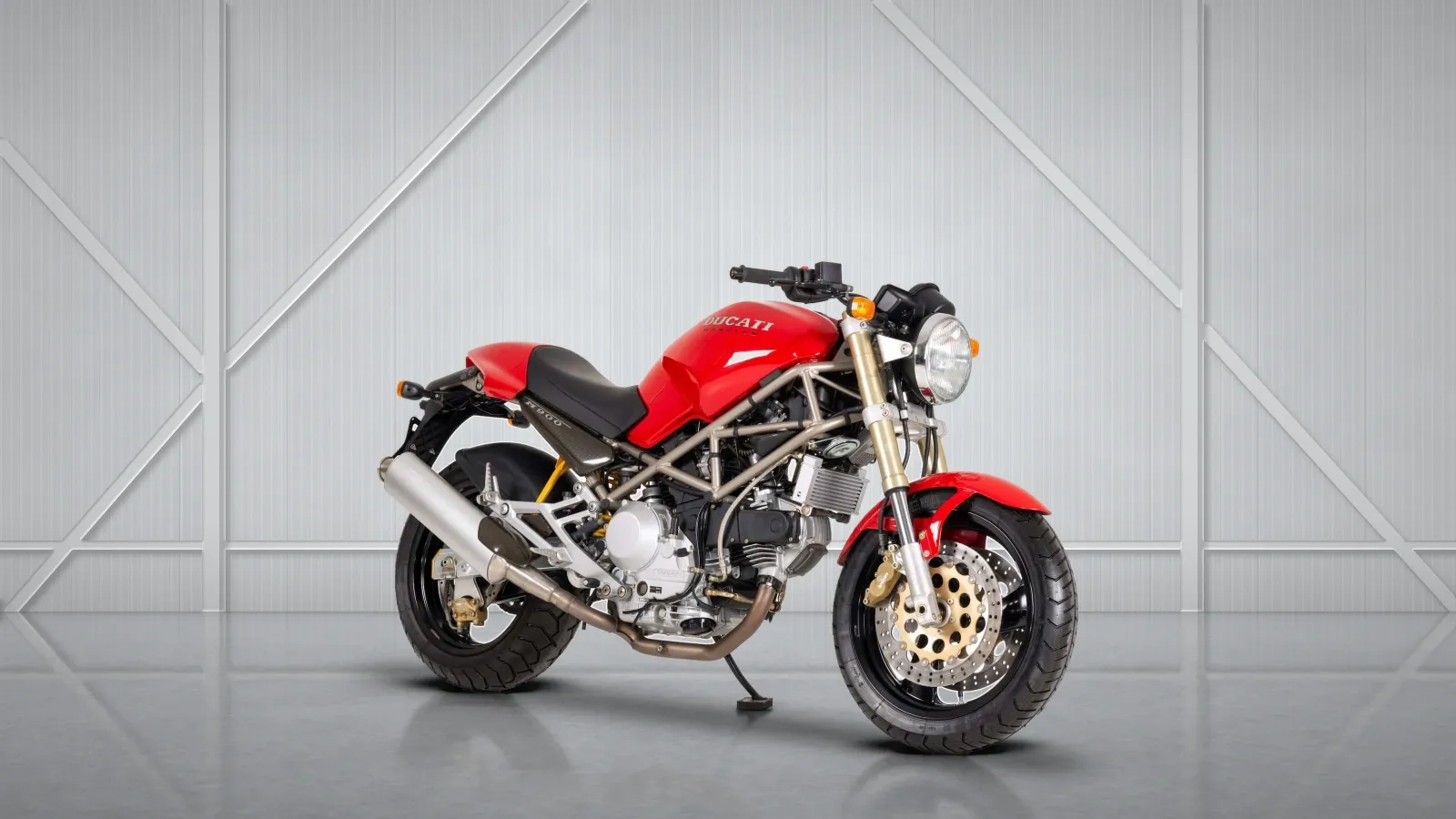

Ducati Monster 900: how the original Monster took shape
Read Ducati Monster 900: how the original Monster took shapeHow the 1992 Monster prototype became the 1993 M900, and why its stripped-back Ducati hardware helped define the sports-naked idea.

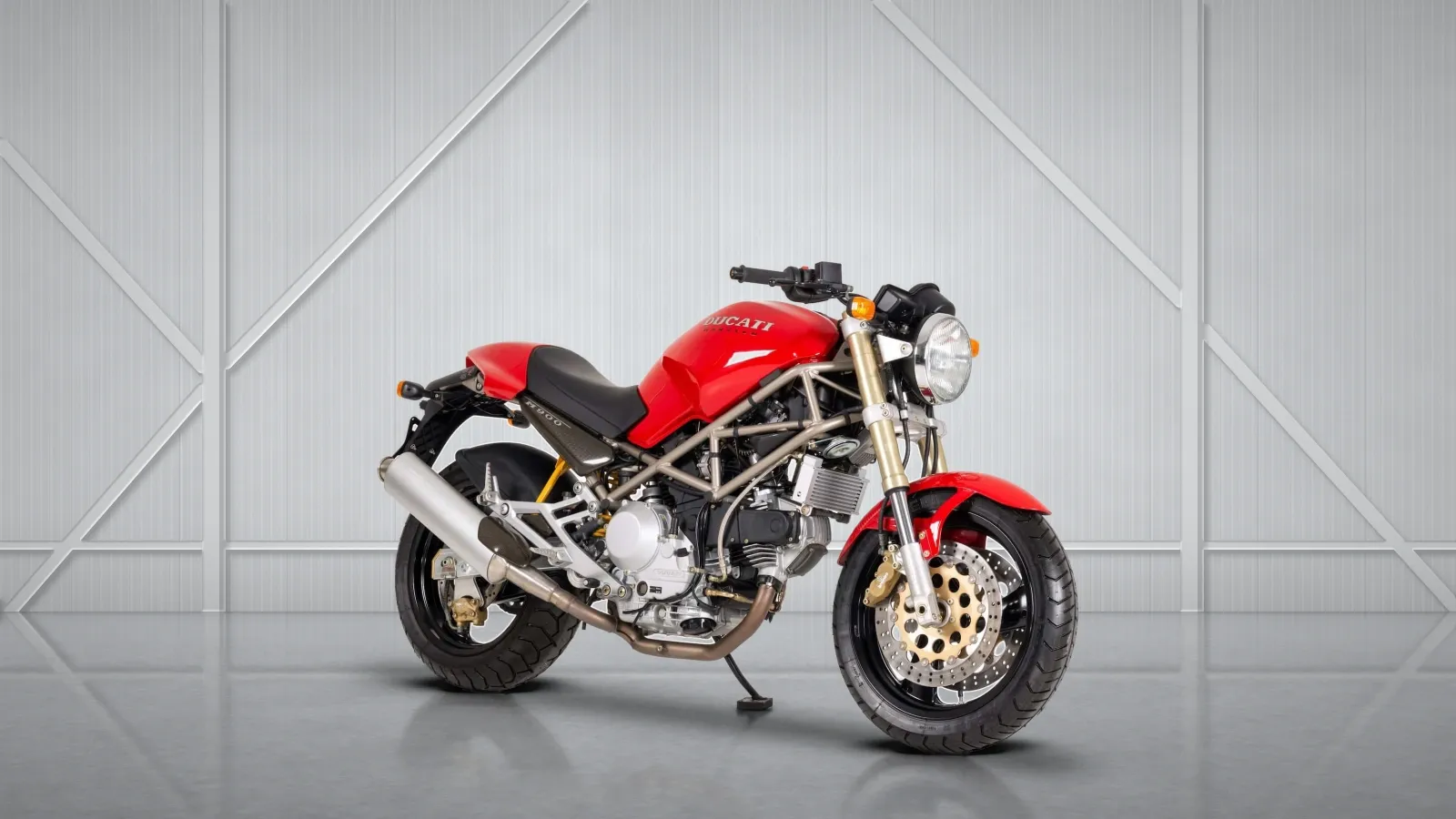

History, specifications and context for the Ducati Monster 900.
The Ducati Monster 900 was the first production Monster, and the idea was almost disarmingly simple: expose the motorcycle rather than hide it. Ducati showed the prototype at Cologne in October 1992 and put the 900 cc version into production in 1993, combining a stripped-back layout with a 904 cc air/oil-cooled twin and tubular trellis chassis.
Here, Monster 900 means the original 1993 carburetted M900. That matters because the 900 S, injected 900 i.e., smaller-capacity Monsters and later liquid-cooled generations all moved the idea on in different directions, and their specifications don’t travel backwards to the first bike.
Ducati dates the Monster's public debut to Cologne in 1992, but its own chronology says the 900 cc Monster entered production in 1993. Period Cycle World reporting from July 1993 describes the M900 as finally in production after its reception at the Cologne show.
That makes 1993 the production-market introduction year for the original Monster 900. The 1992 date remains the prototype/show debut, not the road-production introduction.
The 1993 production M900 used a 904 cc, 92 x 68 mm, two-valve air-and-oil-cooled engine with 38 mm Mikuni carburettors. Ducati's current Monster Heritage pages give 73 hp for the Monster 900 without stating a model year or configuration.
Cycle World noted that the M900 used the 900SS engine/transmission combination with no engine changes beyond lower overall gearing. Its quoted 75.7 rear-wheel horsepower figure came from an earlier 900SS dyno run, so it is engine-family context rather than an M900 power measurement. Ducati's 73 hp is the only published output figure for the Monster 900, and no period source gives a separate one for the 1993 motorcycle. The engine speed at which it is produced is not settled.
The 1993 production M900 used a six-speed gearbox and chain final drive. Cycle World described the gearchange as slick and quick, with ratios well matched to the engine's midrange delivery.
The six-speed gearbox is established for the 1993 production M900. Exact internal gear ratios for the chosen 1993 reference have not been established.
Ducati describes the 1992 Cologne prototype as using an 851/888-series trellis frame. Cathcart described the 1993 production chassis as the front half of a 900SS frame with a newly designed rear section. Cycle World's production test recorded a 56.3-inch wheelbase, a 24-degree steering-head angle and 3.9 inches of trail.
The 1993 road-test hardware included a 41 mm upside-down Showa fork and a rising-rate rear suspension package, with Cycle World reporting 4.7 inches of front travel and 4.3 inches at the rear.
Cycle World's production M900 used twin 12.6-inch Brembo front discs with four-piston calipers, a 3.5-inch front wheel with a 120/70-17 tyre and a 5.5-inch rear wheel with a 170/60-17 tyre.
Later specifications give conflicting rear-disc diameters of 220 and 245 mm, so no exact diameter is assigned to the 1993 reference. The rear brake is therefore described only as a single rear disc.
Alan Cathcart's July 1993 Cycle World riding impression tested the production M900 and called it an unusually compact, quick-steering street bike with strong midrange response from the carburetted engine. He also praised the suspension over broken surfaces and the braking performance.
The test was not entirely flattering. Cathcart found the clutch less progressive than ideal, said the fork was softly damped, and reported that the silencers touched down during spirited cornering. Those observations come from one early production motorcycle.
The 1993 specification did not hold for the rest of the decade. Retrospective period-based histories record suspension and engine-detail changes during the carburetted years, and Ducati added named versions such as the Monster 900 S by 1998.
Ducati's own chronology marks 2000 as the arrival of the Monster 900 with electronic injection. The injected 900 i.e. therefore sits outside the original 1993 carburetted reference even though it retained 904 cc displacement and the Monster 900 name.
Ducati's current Monster Heritage pages give 185 kg dry and 190 km/h for the Monster 900, again without a stated year; the Italian pages say over 190 km/h. Cycle World reported a claimed dry weight of 408 lb for the 1993 production M900; that is 185.1 kg by conversion, which independently supports the Heritage dry-mass scale for the early production motorcycle.
Fuel capacity is unsettled. An 18-litre figure including reserve appears in listings for a workshop manual covering 1993 to 2003, but no Ducati document specific to the 1993 motorcycle gives a capacity.
The original carburetted Monster 900 is historical and discontinued. Ducati now presents the model through its Heritage collection, while its own chronology records the 2000 switch to electronic injection and later expansion of the Monster family.
If you’re looking at an early Monster, establish the year and configuration before you compare specifications. Carburettors, fork type and adjustment, named S/Special equipment, later injected hardware and owner modifications can all change what’s in front of you.
Used-bike guides consistently put service history ahead of a blanket reliability score. Timing-belt and valve-clearance maintenance, carburettor condition, dry-clutch wear, charging and electrical condition, crash damage and originality tell you more than assuming every M900 carries the same faults.
Ducati Monster 900 — Specification overview
Family scope: 1993 Ducati M900 Monster — original carburetted standard road-production reference
| Configuration | 904 cc air/oil-cooled two-valve Ducati twin |
|---|---|
| Displacement | 904 cc |
| Bore × Stroke | 92 × 68 mm |
| Valvetrain | Two valves per cylinder; desmodromic actuation |
| Fuel System | 2 × 38 mm Mikuni carburettors |
| Cooling | Air/oil-cooled |
| Gearbox | 6-speed |
| Clutch | Dry multi-plate, hydraulically operated — exact 1993 specification not independently established |
| Final Drive Ratio | Chain |
| Engine Capacity | 904 cc |
| Power Output | 73 hp (54 kW) — General Ducati Monster 900 manufacturer output; not assigned by Ducati to a model year/configuration |
|---|---|
| Torque | 76 Nm @ 6,000 rpm |
| Top Speed | 190 km/h — General Ducati Monster 900 manufacturer figure; Italian locale states over 190 km/h |
| Frame Type | Tubular steel trellis |
|---|---|
| Wheelbase | 1,430 mm |
| Rake / Trail | 24° / 3.9 in |
| Weight | 185 kg (dry) |
| Front Suspension | Showa; 41 mm upside-down fork; Travel: 4.7 in |
|---|---|
| Rear Suspension | Showa identified by Cycle World; Rising-rate linkage single shock; Travel: 4.3 in |
| Front Brakes | Twin 12.6 in Brembo discs; Calipers: Four-piston Brembo calipers |
|---|---|
| Rear Brakes | Single rear disc |
| Front Wheel | 3.5 × 17 |
| Rear Wheel | 5.5 × 17 |
| Front Tyre | 120/70-17 |
| Rear Tyre | 170/60-17 |
How the 1992 Monster prototype became the 1993 M900, and why its stripped-back Ducati hardware helped define the sports-naked idea.