
Ducati Monster 900: how the original Monster took shape
Read Ducati Monster 900: how the original Monster took shapeHow the 1992 Monster prototype became the 1993 M900, and why its stripped-back Ducati hardware helped define the sports-naked idea.

“Naked” sounds as if it should mean one simple thing: remove the fairing and you are done. But the Ducati Monster 900, MV Agusta Brutale 800 and Rush 1000, and Aprilia Tuono V4 show why that is too crude. Their engines and frames are deliberately more exposed, and their road-focused layouts put the rider and mechanical package in view rather than enclosing everything in full sports bodywork. Their proportions, power and wind protection are far from identical.
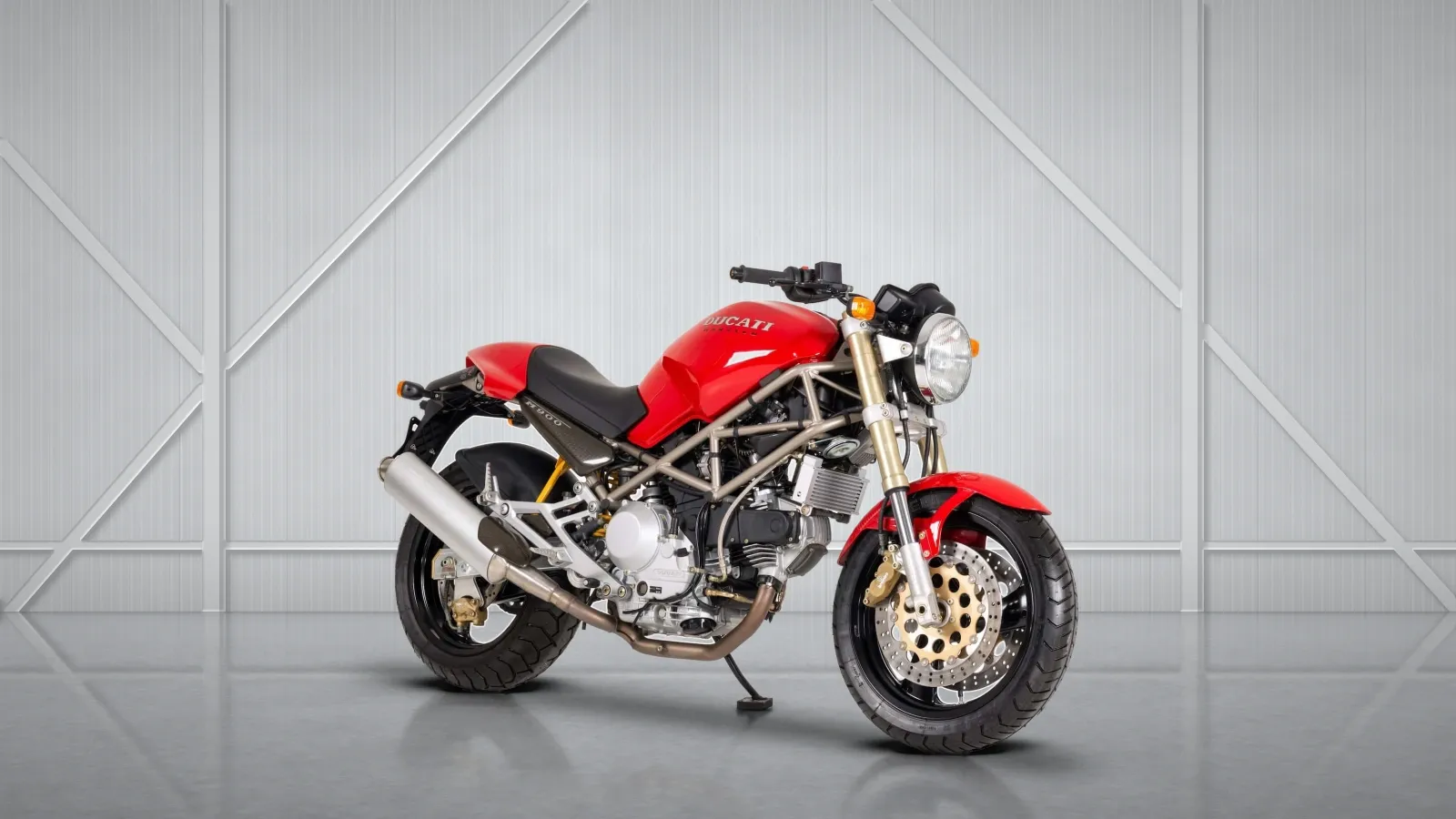
Ducati’s own history of the Monster 900 describes the design as intentionally naked, with the engine and frame turned into visible form. MV Agusta says the Brutale was conceived as a naked bike from the start rather than created by stripping a finished faired motorcycle. Those are strong clues to the category’s real identity.
At the performance-heavy end sits the hypernaked: an especially powerful, sharply focused naked road bike that keeps the category’s exposed mechanical look and road-riding layout. MV Agusta calls the Rush a hyper-naked and builds it around Brutale 1000 hardware. Aprilia describes the current Tuono V4 as a hypernaked even though its compact half-fairing, winglets and aerodynamic work give the rider meaningful protection. Naked does not mean absolutely unfaired.
Power does not set a ceiling either. A Rush 1000 or Tuono V4 can offer serious superbike-level performance while remaining a naked motorcycle by design and overall layout. What matters when you compare them is how the rider sits, where the air hits, how the machine is packaged and what its individual engine and chassis are built to do.
A naked bike is not automatically a superbike with its fairing taken off. Aprilia identifies a close technical connection between the Tuono V4 and RSV4; Ducati describes the original Monster as intentionally naked, and MV Agusta says the Brutale was conceived that way from the outset. Compared with a fully faired sportbike, the exposed layout and reduced bodywork change the riding proposition, but actual platform relationships still have to be checked model by model.
If you’re looking at an older Monster alongside a newer Brutale, Rush or Tuono, compare the exact model year, market and variant before treating equipment or performance figures as interchangeable. Bodywork can differ, as can the chassis, electronics and intended road use. The name of the category gives you a starting point; the individual motorcycle tells you the rest.
Showing 1 - 4 of 4 models
 Introduced 2011
The Aprilia Tuono V4 takes Aprilia’s compact V4 performance platform into a high-handlebar road bike, and it has done so as a model family since 2011. The name has moved through several technical phases since then.
 Introduced 1993
The Ducati Monster 900 was the first production Monster, and the idea was almost disarmingly simple: expose the motorcycle rather than hide it. Ducati showed the prototype at Cologne in October 1992 and put the 900 cc version into production in 1993, combining a stripped-back layout with a 904 cc air/oil-cooled twin and tubular trellis chassis.
 Introduced 2012
The 2026 MV Agusta Brutale 800 is the 798 cc three-cylinder side of MV Agusta’s naked-bike range. The numbers are serious enough on their own: 83 kW (113 hp) at 11,000 rpm at the crankshaft, 85 Nm at 7,500 rpm and a cassette-style six-speed constant-mesh gearbox.
 Introduced 2020
The original MV Agusta Rush 1000 is a 998 cc four-cylinder naked bike first shown in 2019 and put into production in 2020. MV Agusta described a 300-unit run in May 2020, with production due to begin in June and the first bikes leaving Varese by the end of that month.
Showing 1 - 2 of 2 articles
How the 1992 Monster prototype became the 1993 M900, and why its stripped-back Ducati hardware helped define the sports-naked idea.

Four MV Agustas, two engine families: how the F3 RR, Brutale 800, Superveloce 1000 Serie Oro and original Rush differ in tune, gearing and purpose.

