What is Ducati?
Ducati is an Italian motorcycle manufacturer based in Borgo Panigale, Bologna, and the factory location is still a big part of how the company presents itself. The operating company is Ducati Motor Holding S.p.A., which sits within the Audi Group and, through Audi, the wider Volkswagen Group. Claudio Domenicali is Ducati's chief executive as of 14 September 2026.
Ducati didn’t begin with motorcycles at all. The business was founded in Bologna in 1926 as an electronics company, and its move into motorised two-wheelers only came after the Second World War. Today Ducati develops road and off-road motorcycles and runs factory programmes in MotoGP, WorldSBK, motocross and Supercross.
From radio components to motorcycles: 1926 and 1946
On 4 July 1926, Antonio Cavalieri Ducati and his sons Adriano, Bruno and Marcello founded Società Scientifica Radio Brevetti Ducati in Bologna. Its early work was in radio communication technology and components. As the company expanded, construction of the Borgo Panigale factory began in 1935; the site was badly damaged by Allied bombing in October 1944.
The motorcycle story starts separately. Ducati's own heritage record traces the Cucciolo to designers Aldo Leoni and Aldo Farinelli at SIATA in Turin. Ducati bought the manufacturing rights and began producing the auxiliary bicycle engine at Borgo Panigale in March 1946. The Cucciolo marked Ducati's industrial turn from electronics towards motorised two-wheelers; the Ducati brothers' business passed into state control in 1948.
In the 1950s Ducati's motorcycle identity changed again under engineer Fabio Taglioni. Ducati's heritage material dates its first desmodromic racing application to 1956. That engineering thread later became closely associated with the company, but it sits decades after the 1926 electronics foundation and ten years after the first Cucciolo production.
Those dates describe different things: 1926 is the foundation of the original Ducati company, while 1946 is the start of Ducati's motorcycle activity.
Who owns Ducati now?
Ducati Motor Holding S.p.A. is a sole-shareholder company subject to the management and coordination of Audi AG. Audi describes Ducati as part of the Audi Group, while Volkswagen lists Ducati in its brand portfolio as directly controlled by Audi. Audi acquired Ducati in 2012 through its controlled company Automobili Lamborghini S.p.A.
The ownership path before Audi includes several material changes. The business passed into state control in 1948; Cagiva acquired the Ducati brand and business in 1985; a new Ducati Motor Holding structure backed by Texas Pacific Group and Deutsche Morgan Grenfell acquired the motorcycle business in 1996; Investindustrial took a 29.9% stake in 2006 and, with co-investors, reached 100% in 2008 before the 2012 sale.
Ducati Motor Holding S.p.A. was incorporated in 1996 to acquire the Ducati motorcycle business from Cagiva; the remaining Cagiva shareholding was bought out in 1998. That is different from saying the Ducati marque itself began in 1996.
Volkswagen has been reviewing parts of its brand portfolio. In September 2026, Audi chief executive Gernot Döllner told Bloomberg that Ducati is among around 600 of Volkswagen's 2,000 businesses under review, and that nothing had been decided. As of 14 September 2026, Ducati remains under Audi control within Volkswagen Group.
Borgo Panigale, Bologna and where Ducati motorcycles are made
Borgo Panigale remains Ducati's centre of gravity. Ducati describes the Bologna site as its main headquarters, where motorcycles are designed, assembled and prepared for shipment. The factory and Ducati Museum share the Via Antonio Cavalieri Ducati 3 site, which is also the registered-office address used by Ducati Motor Holding S.p.A.
Production is not limited to Bologna. Audi's 2025 production-site reporting lists Ducati motorcycle production in Bologna, Manaus in Brazil and Map Yang Phon in Thailand. In Argentina, Ducati also uses Volkswagen Group's Córdoba Industrial Centre for local assembly; Ducati reported in 2026 that locally assembled Multistrada V2 motorcycles were being delivered there.
Audi's 2025 reporting names the models produced at each location. Bologna remains the broadest Ducati site, while the Thailand plant builds several road-bike families for its region and the Brazil site assembles selected families. Local assembly in Argentina is aimed at that market. Where a Ducati is built therefore depends on the model and the destination market.
Racing: MotoGP, WorldSBK and off-road
Ducati's factory racing programmes span MotoGP, the FIM Superbike World Championship and off-road competition. The two road-racing championships count different things, while Ducati Corse Off-Road runs a separate motocross and Supercross programme.
In MotoGP, Ducati secured the 2025 Constructors' Championship, its seventh constructors' title overall and sixth in succession from 2020 to 2025. Marc Márquez also won the 2025 Riders' Championship for Ducati, giving the manufacturer a fourth consecutive riders' title from 2022 to 2025. The 2026 season is still running.
In WorldSBK, the championship organiser confirmed Ducati's 22nd Manufacturers' Championship in July 2026, its fifth in succession from 2022 to 2026. That title is a manufacturer result; the same Donington Park weekend also gave Aruba.it Racing - Ducati the Teams' Championship, which is a separate classification.
Ducati's WorldSBK record is also tied to its production-derived superbikes. The 851 and its successors helped establish the company's championship identity in the early WorldSBK era, while the modern Panigale line continues that programme. MotoGP is a separate prototype championship, entered by Ducati in 2003; the Desmosedici RR later brought some of that Grand Prix project into a limited road motorcycle.
Ducati's third factory programme is off-road. Ducati Corse Off-Road, formed as a division of Ducati Corse, races the Desmo450 MX in the MXGP World Championship and made Ducati's first AMA Supercross start at Anaheim in January 2026.
Ducati engine language: 90-degree twins, L-twins, desmo and V4
Ducati uses both 'L-Twin' and 'V2 - 90°' in its official engine material. Both labels refer to Ducati's 90-degree twin tradition; the engine family and valve system are separate questions.
Desmodromic valve control is another recurring Ducati term, but it is not a synonym for every Ducati engine. Fabio Taglioni introduced desmodromic timing to Ducati racing in the 1950s. In a desmodromic system, valve opening and closing are mechanically controlled rather than relying only on a conventional return spring. Ducati still uses Desmo on engines such as the Desmosedici Stradale V4 and Testastretta 11-degree twin.
Ducati's Testastretta material uses L-Twin wording, while the latest 890 cc V2 is described as a 90-degree V2 with spring-return valves. The V4 Granturismo is likewise a 90-degree V4 with a spring valve-return system, while the Desmosedici Stradale is a 90-degree V4 with desmodromic timing. The current range shows the limits of any single label.
Five motorcycles that mark different Ducati paths
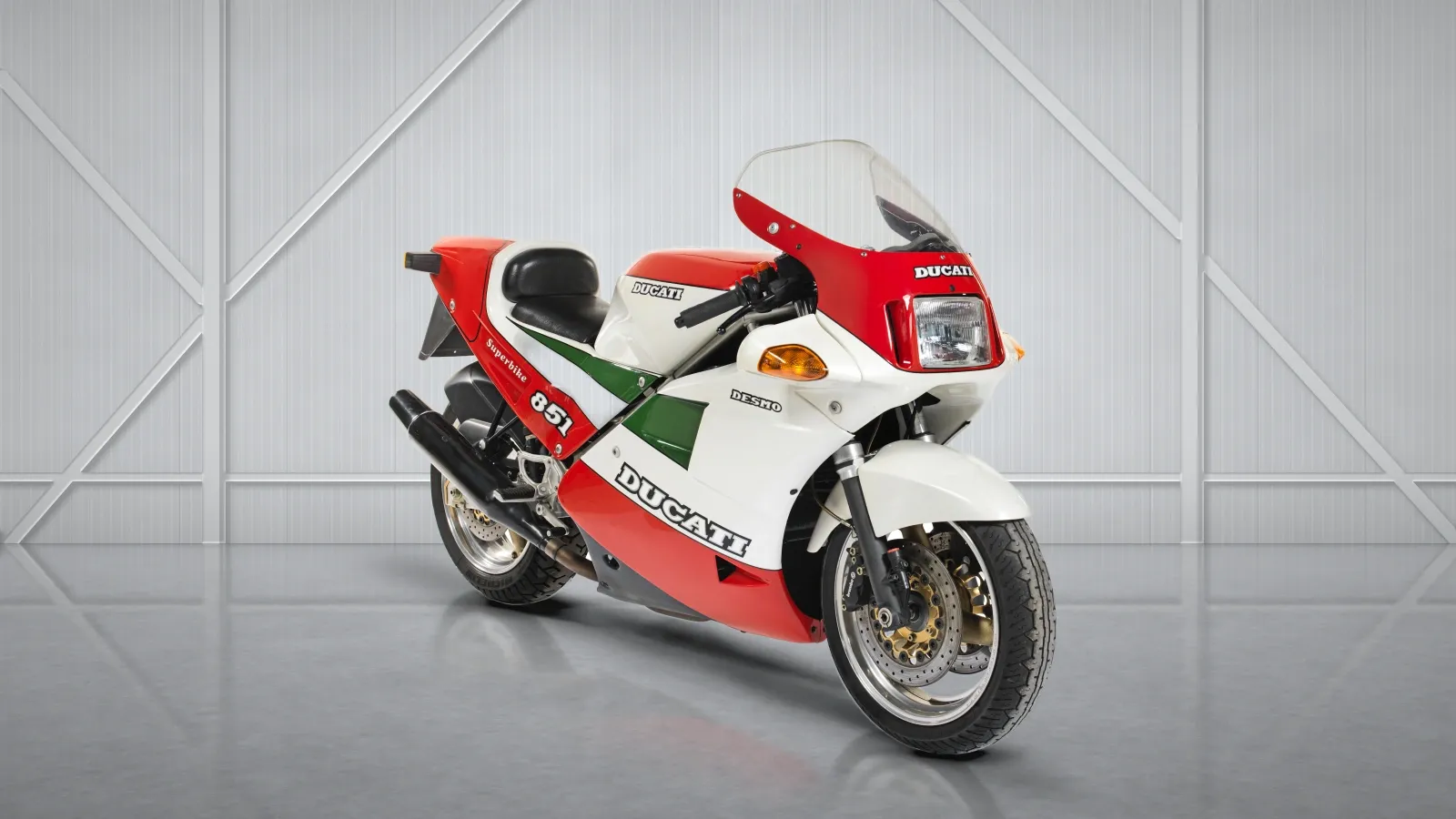
Five motorcycles mark different turns in Ducati's road-bike history. The 851 Tricolore introduced Ducati's Desmoquattro generation: Ducati describes it as its first desmodromic four-stroke twin with liquid cooling, four valves per cylinder and electronic fuel injection, and as the start of a new modern superbike era.
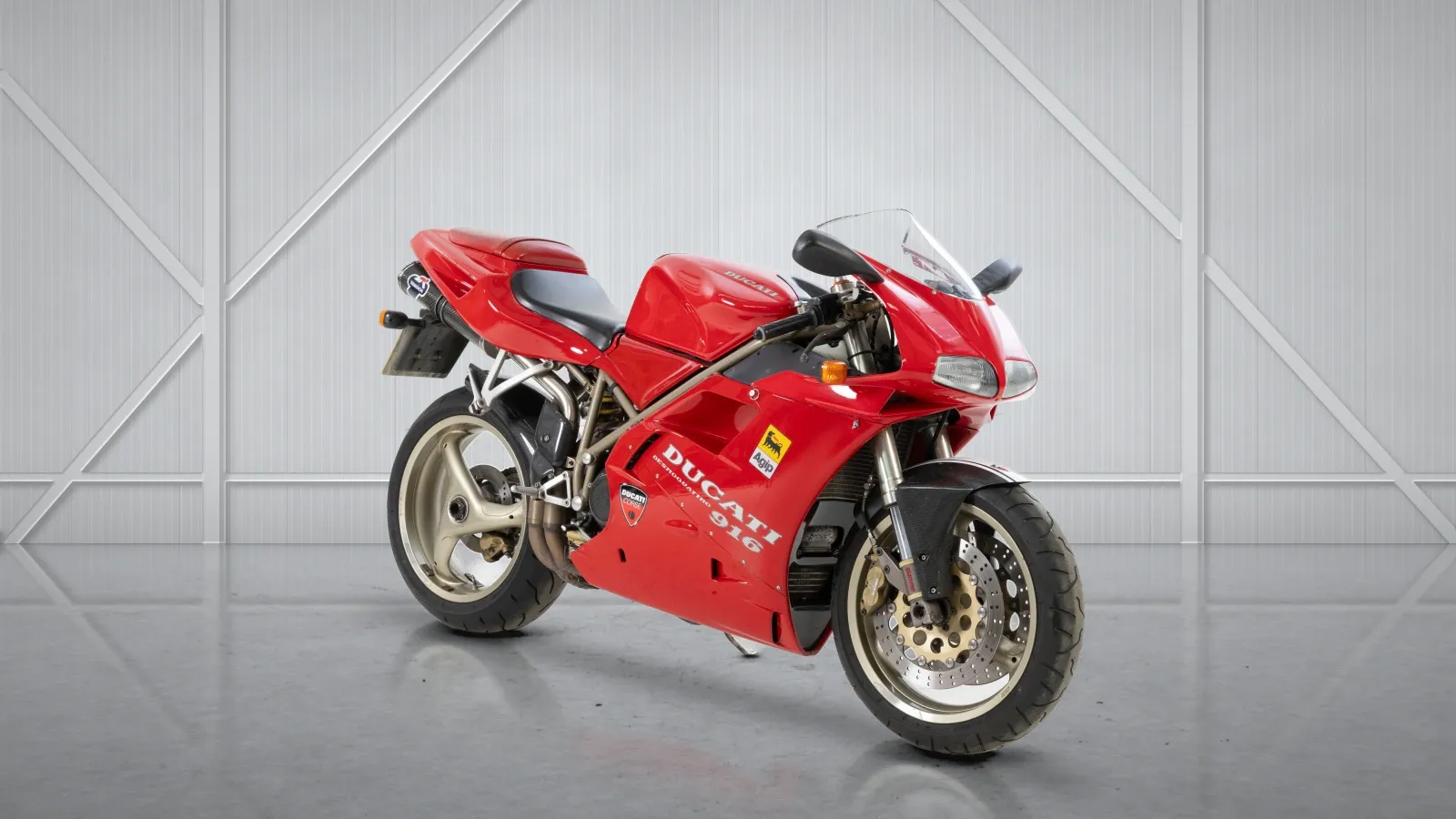
The 916, introduced in the 1990s, joined Massimo Tamburini's compact bodywork and single-sided-swingarm design with Ducati's superbike programme. Ducati links the 916 family closely to its WorldSBK success, including multiple manufacturers' championships during the decade.
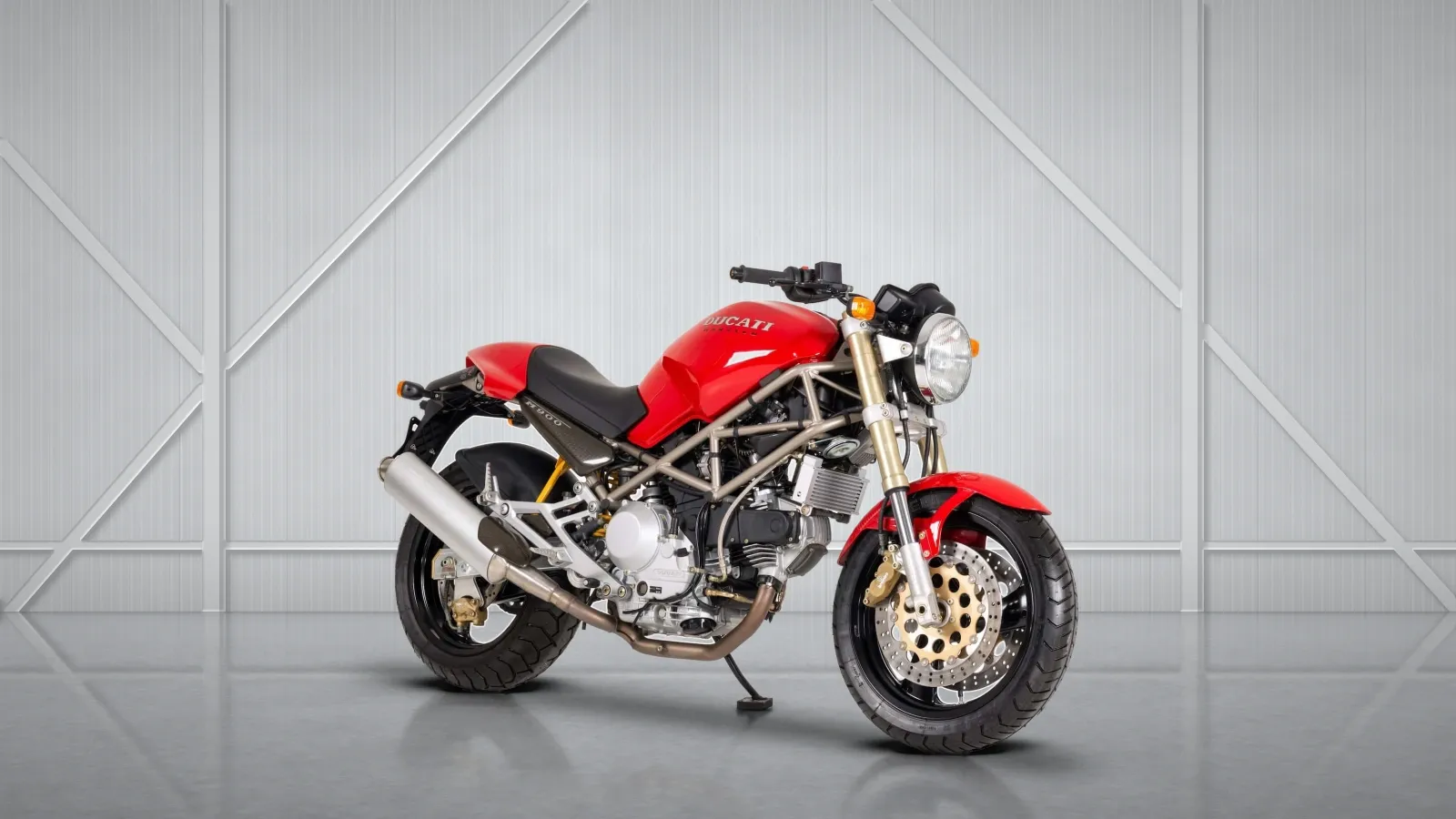
The Monster 900 took Ducati in another direction. Shown at Cologne in 1992, it exposed the frame and engine instead of wrapping them in sports-bike bodywork and established the Monster family as Ducati's naked-bike line.
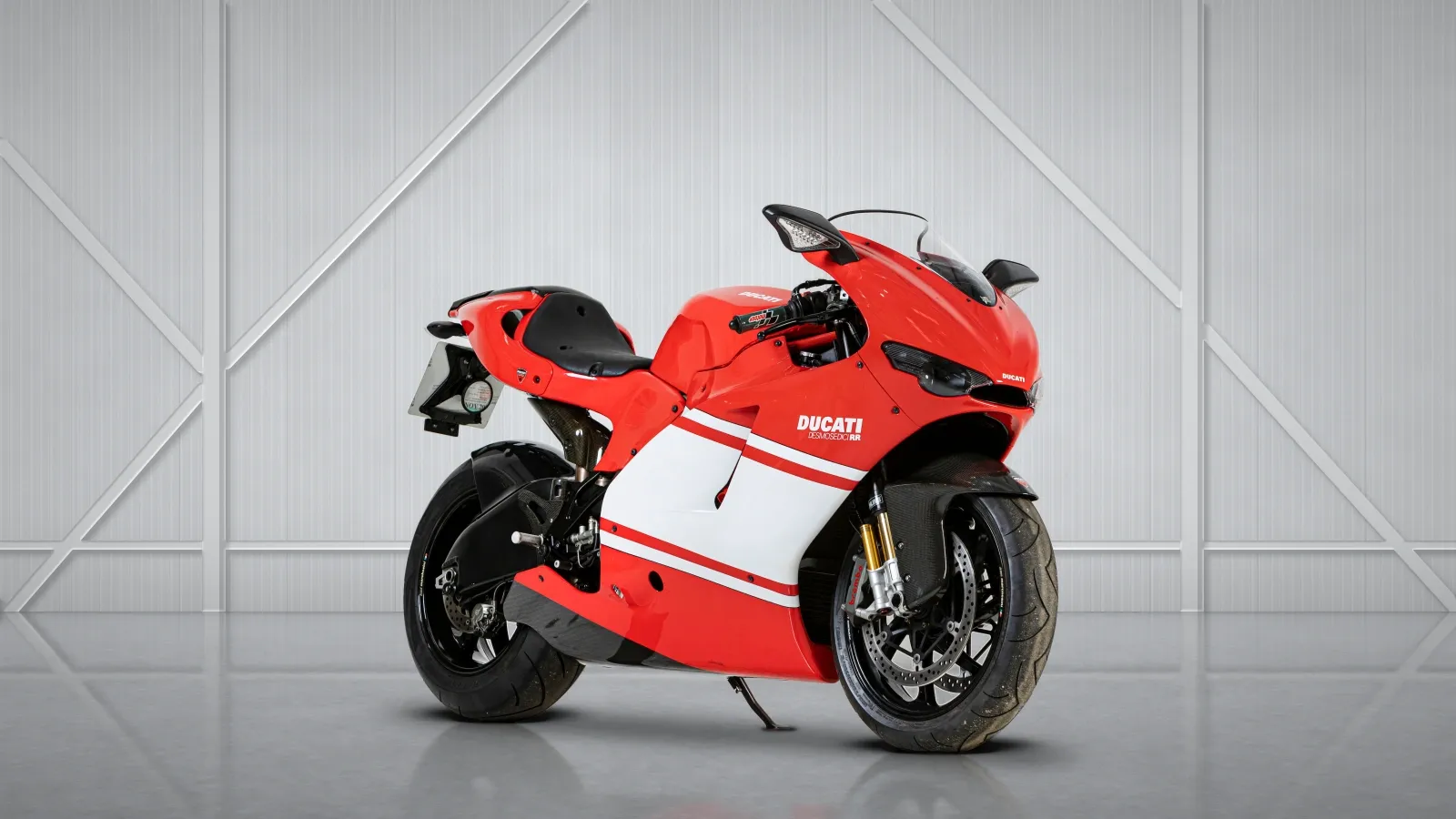
The Desmosedici RR was a much more direct bridge from Grand Prix racing. Ducati presented it as a road-going MotoGP replica, produced in a limited series of 1,500 motorcycles after the company's return to premier-class Grand Prix racing with the Desmosedici project.
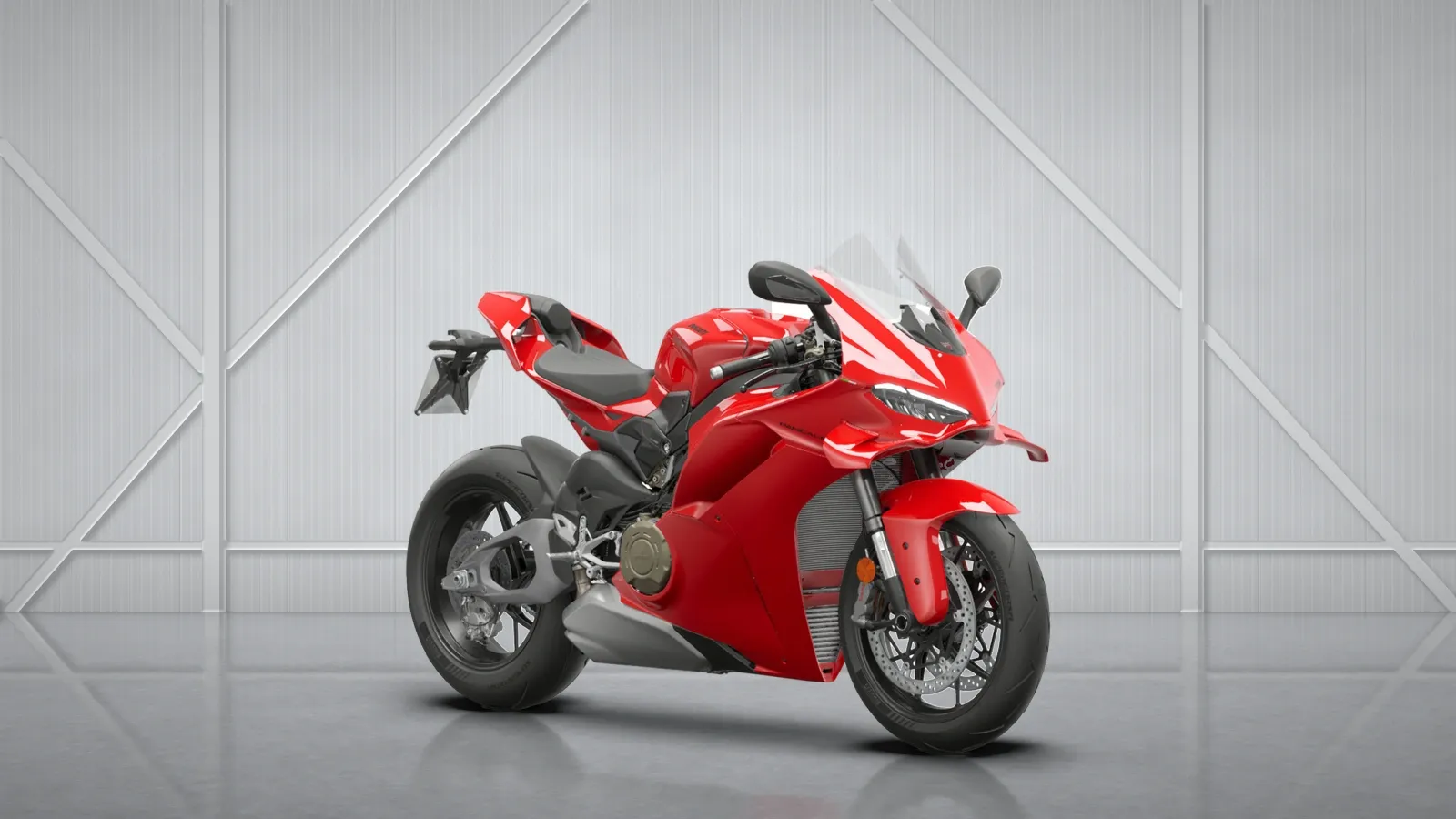
The Panigale V4 represents Ducati's current four-cylinder superbike route. Ducati describes the latest generation as drawing on MotoGP-derived solutions while remaining a road production motorcycle. Together, the five machines show shifts in engine technology, body format and the relationship between road and racing.
Ducati's wider range today
Ducati's UK range in September 2026 spans families including Panigale, Streetfighter, Monster, Multistrada, Hypermotard, Diavel and XDiavel, DesertX and Scrambler, alongside off-road motorcycles. The exact line-up changes with model years and markets.
That breadth also explains why no single Ducati engine description fits every current motorcycle. The range now includes singles, 90-degree twins and different V4 families, while road, adventure, naked, sport and off-road motorcycles place different demands on the same manufacturer.
The 851, 916, Monster 900 and Desmosedici RR are no longer in production; the Panigale family is. The five motorcycles therefore mix historic milestones with a current superbike family.
Warranty, servicing, parts and dealers in the UK
Ducati's UK warranty states that every road motorcycle is covered for at least 24 months from registration with unlimited mileage. The conventional warranty is international, transfers with the motorcycle to a new owner and includes roadside assistance. Separate terms apply to motocross, cross-country and enduro motorcycles.
Some families receive longer cover. Ducati's 4Ever programme gives eligible Multistrada and DesertX motorcycles from model year 2020 onward four years of cover with no mileage limit, subject to its conditions and scheduled maintenance through the authorised network. Factory Ever Red can extend the conventional warranty by a further 12 or 24 months for eligible motorcycles.
Ducati provides a UK dealer locator with filters for authorised service and Master Tech service, and publishes model-specific owner's manuals, maintenance schedules and parts catalogues online. Ducati Genuine Parts carry a 24-month warranty with unlimited mileage, and Ducati states that its parts distribution network covers more than 80 countries.
Scheduled maintenance is model-specific. Ducati's online service tools let owners select a motorcycle and year to retrieve maintenance information rather than applying one interval across the range. That matters particularly when comparing older belt-driven twins, newer V2 engines and V4 families, whose service requirements can differ substantially.
These are Ducati's own terms. What an individual owner experiences will also depend on the dealer and the motorcycle.
What can be said about Ducati reliability?
No published dataset covers Ducati reliability across its different decades, engine families and uses. A 1990s 916, an air-cooled Monster 900, a Desmosedici RR and a current Panigale V4 have different service demands, known issues and parts contexts.
Owner surveys and used-bike guides can be useful, but only when you keep them at model level. If you’re looking at an individual Ducati, the stronger checks are specific to that bike: service and recall history, evidence that scheduled maintenance has been completed, the exact engine and model-year requirements, modifications, accident or track history, and access to suitable dealer or specialist support.
Ducati's own current warranty intervals and service programmes show that the company has developed its maintenance offer, but warranty length or a long valve-clearance interval is not the same thing as an independent reliability result.
Ducati today
Ducati delivered 50,895 motorcycles worldwide in 2025, down from 54,495 in 2024. Turnover was €925 million against €1,003 million, and operating profit €52 million against €91 million, giving a margin of 5.6% where 2024 returned 9.1%. Ducati attributed the fall to a contracting market, United States tariffs, exchange rates and the Euro 5+ transition, which limited availability of the Monster, Hypermotard and DesertX. Volkswagen describes Ducati as employing about 2,000 people.
At its centenary in 2026, Ducati is still centred on Borgo Panigale, even though the company now sits inside a much larger automotive group, manufactures in more than one country and competes at factory level in MotoGP, WorldSBK and off-road racing. The scale has changed. The Bologna centre of gravity hasn’t.