
Why Ducati moved from the 999 to the 1098
Read Why Ducati moved from the 999 to the 1098The Ducati 1098 followed a successful 999 racing era with a new Testastretta Evoluzione engine, revised chassis and a return to familiar superbike styling.


History, specifications and context for the Ducati 1098.
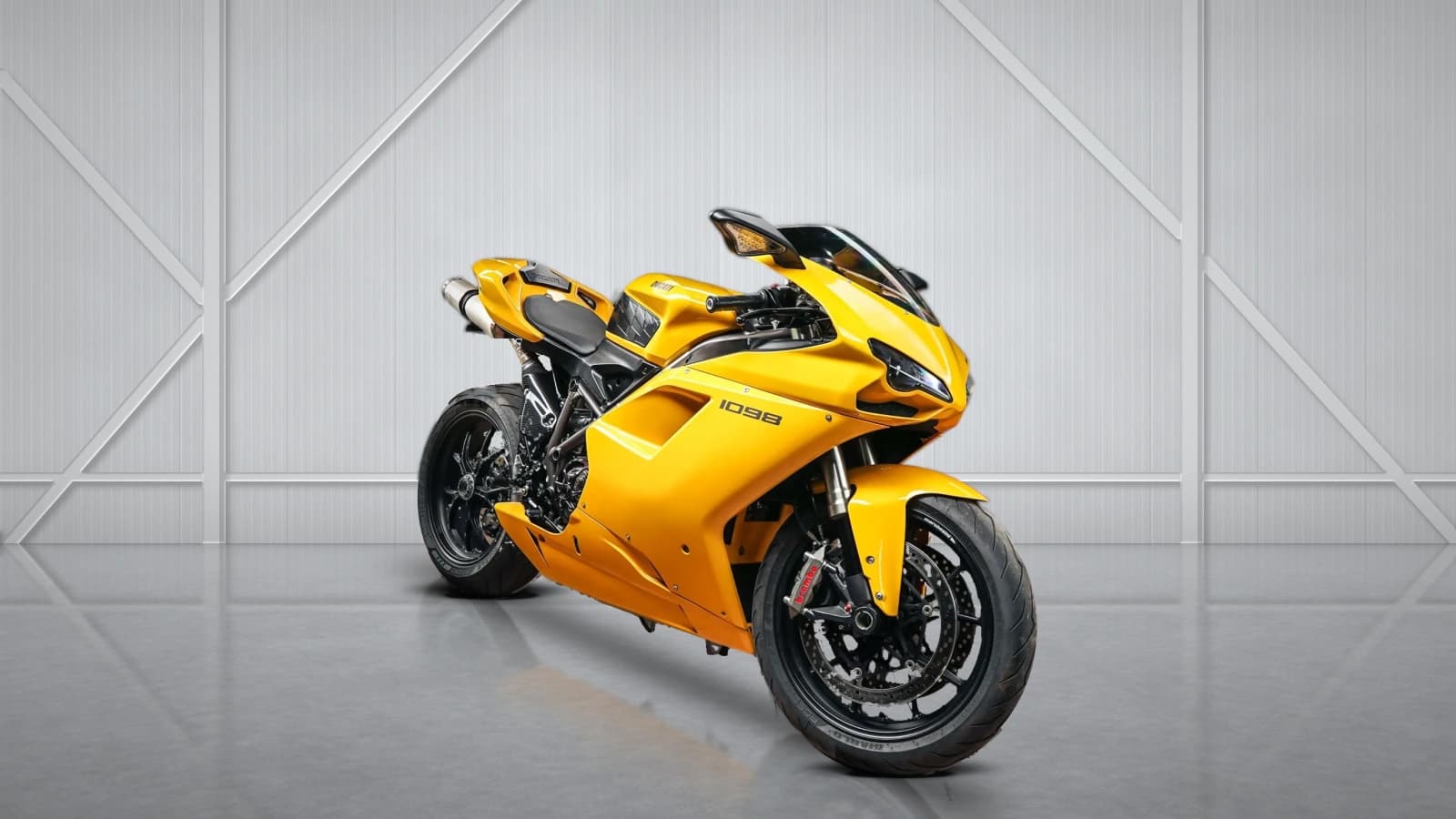
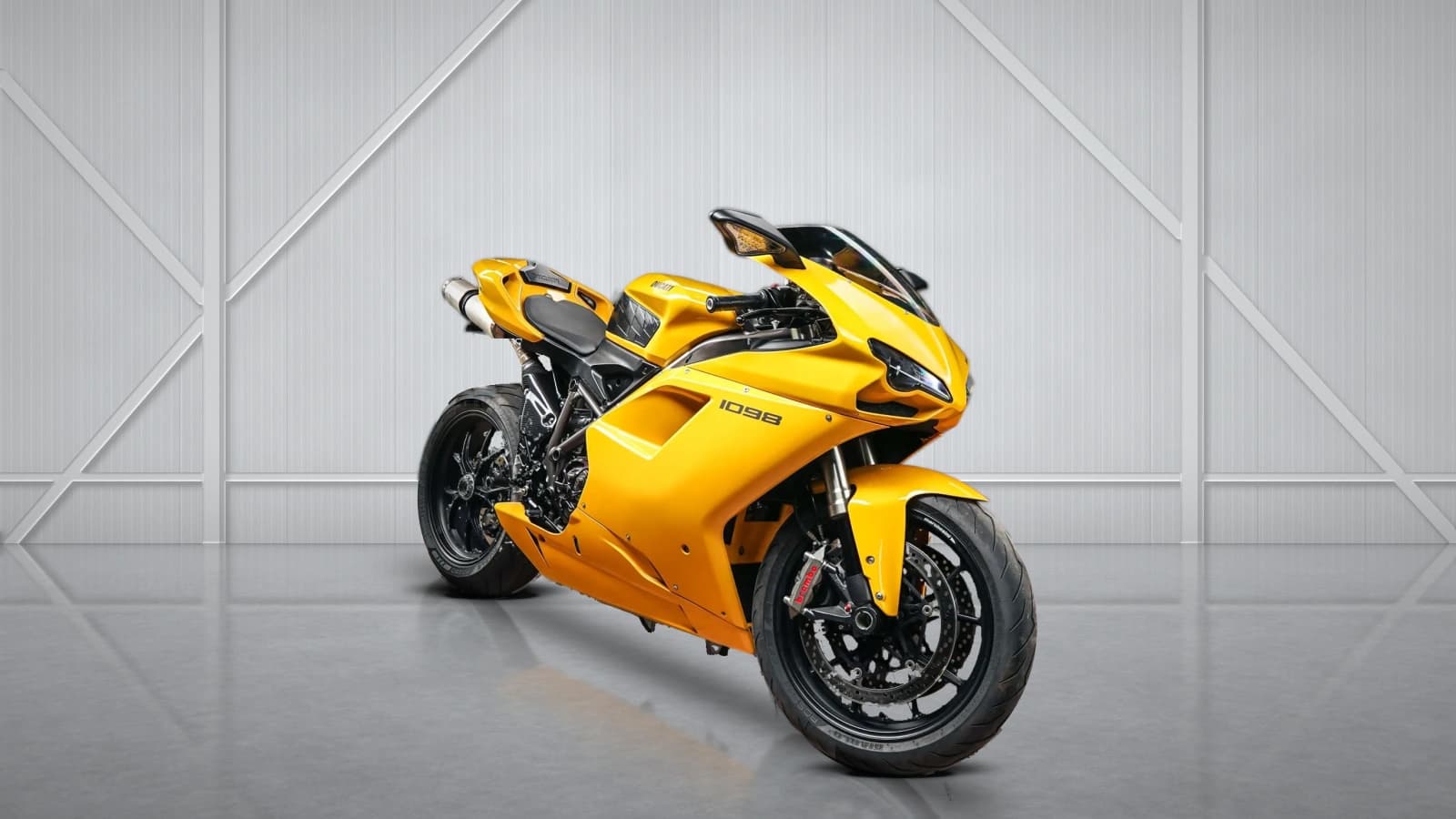
The Ducati 1098 is a fully faired Italian superbike introduced for the 2007 model year. Its central feature is a 1,099 cc Testastretta Evoluzione V-twin, housed in a steel-tube trellis frame with a single-sided rear swingarm. Twin headlights, a compact tail and two underseat exhaust outlets give it a recognisable Ducati silhouette, but the motorcycle is defined by considerably more than its styling.
The original standard 1098 combined the new engine with adjustable Showa suspension, Brembo front brakes, electronic fuel injection and a six-speed transmission. Its engine uses Ducati’s desmodromic valve system, in which separate rocker mechanisms open and close the valves rather than relying on conventional closing springs alone.
This profile concerns the original 2007 European/UK standard Ducati 1098. The contemporary 1098 S and later 1098 R carried different equipment and, in the R’s case, a fundamentally different engine capacity. Their specifications should not be assumed to apply to the standard motorcycle.
Ducati presented the 1098 generation in late 2006 for the following model year. It sat at the centre of the company’s road-superbike range, continuing the water-cooled, desmodromic V-twin tradition established through earlier Ducati superbikes.
The 1098 name is a model designation, not its exact capacity: the standard engine displaces 1,099 cc. In its original form, the motorcycle was a road-registered superbike with lights, mirrors and road equipment, not a factory World Superbike machine. A dedicated racing programme subsequently developed around related but distinct motorcycles.
Ducati offered more than one version of the 1098 family. The standard 1098 is the correct starting point for understanding what an original base motorcycle included; optional equipment and higher-specification variants belong to their own descriptions.
The 1098’s liquid-cooled engine is a 90-degree L-twin: its two cylinders are arranged at a right angle and positioned in Ducati’s familiar forward-and-upright layout. With a 104 mm bore and 64.7 mm stroke, it has an especially wide bore relative to the piston’s travel. The architecture provides room for large valves while keeping piston travel comparatively short for each revolution.
Testastretta Evoluzione identifies a development of Ducati’s earlier Testastretta cylinder-head and combustion design. It does not mean the standard 1098 shared every internal component with a 999 R, 1098 R or later Ducati twin. The engine retained double overhead camshafts, four valves per cylinder and belt-driven camshaft timing, alongside electronic fuel injection.
Desmodromic valve actuation is central to Ducati’s engine identity. A conventional four-stroke motorcycle usually uses a cam to open each valve and a spring to close it. Ducati’s desmodromic system uses mechanical opening and closing rockers. Accurate valve-clearance adjustment remains important, and the system has its own specialist servicing requirements.
Ducati’s original workshop figures also show why performance claims need context. The 2007 documentation lists 113 kW at 9,750 rpm under its 95/1/EC crankshaft method and 117 kW at the same engine speed using an acceleration-bench method. Torque is likewise listed under different methods. These are two manufacturer measurement bases for the same engine, not evidence of two separate standard models.
The standard 1098 uses a six-speed gearbox and a hydraulically operated dry multi-plate clutch. Unlike a wet clutch, which operates in engine oil, the dry clutch’s friction plates work outside the engine’s oil bath. That distinction matters when identifying an original motorcycle and when assessing modifications or replacement parts.
Power passes to the rear wheel through a chain final drive. The original drivetrain is part of the bike’s 2007 road specification; specialist slipper-clutch equipment associated with other versions should not be assigned to an untouched standard 1098.
A steel-tube trellis frame forms the main chassis structure. Its visible triangulated tubes are an integral engineering feature rather than decorative bodywork. The engine, frame and suspension work together to locate the wheels and maintain steering geometry under braking, cornering and acceleration.
The 1098’s aluminium single-sided rear swingarm supports the rear wheel from one side. It became a conspicuous visual signature of this Ducati generation, exposing more of the rear wheel when seen from the opposite side. It also brings particular wheel-mounting and hub-service arrangements; its appearance alone tells little about how an individual motorcycle has been maintained.
The period workshop manual identifies a 1,430 mm nominal wheelbase and a standard-model Showa steering damper. A specification such as wheelbase describes a physical dimension; it cannot, by itself, establish that one superbike handles better than another.
The original standard 1098 was equipped with a 43 mm upside-down Showa fork with adjustments for compression damping, rebound damping and spring preload. At the rear, a Showa monoshock works through a progressive linkage and provides its own adjustments. This is an important identification point because the 1098 S was fitted with Öhlins equipment instead.
The standard motorcycle used cast-alloy road wheels rather than treating the specialist wheel equipment of more expensive variants as universal. Ducati paired its sport-focused chassis with radial-mount Brembo front brake callipers and twin front discs. Equipment should still be checked against the correct model-year documentation, especially on motorcycles that have received replacement components.
Tyres, brake discs, callipers and suspension internals are all possible areas of modification on surviving examples. The presence of an upgraded fork or attractive wheel does not establish that the part was delivered as original standard 1098 equipment.
Electronic fuel injection was already part of Ducati’s superbike engineering before the 1098. The original 2007 machine used an engine-management ECU, sensors and digital instrumentation, with the ability to display operating information and warnings.
That should not be confused with later generations of electronic rider aids. The original standard 1098 did not carry the 1098 R’s Ducati Traction Control hardware and racing-ECU arrangement. Nor should its electronic injection be described as evidence of modern lean-angle-sensitive traction control or cornering ABS.
Ducati Data Analyser was part of the wider period electronics story, allowing relevant riding information to be recorded and examined with the appropriate equipment. Whether a particular bike has the associated hardware and accessories should be established from its original sales specification and surviving documentation, rather than inferred from a dashboard menu alone.
From the front, the 1098’s pair of side-by-side headlights give it a direct connection to Ducati’s earlier superbike visual language. Its sharp fairing, sculpted fuel tank, compact tail and twin underseat outlets nevertheless belong to a distinct 2007 design.
The low handlebars, relatively high foot controls and narrow-waisted V-twin layout establish a sport-oriented riding position. Comfort depends on the individual rider, the motorcycle’s condition and any changes to the controls or seat. There is no sound basis for calling the 1098 universally comfortable or uncomfortable without that context.
The design also makes the motorcycle easy to confuse with related versions at a glance. Paintwork and decals may have been altered over time. Engine/frame numbers and original equipment provide a stronger identification trail than graphics alone.
The standard 1098 and 1098 S belong to the same original road generation, but the S has different factory suspension and wheel equipment. A standard machine fitted later with Öhlins forks does not automatically become an original factory 1098 S.
The 1098 R arrived as a separate specialist road-homologated motorcycle for 2008, using a larger 1,198.4 cc engine and equipment associated with Ducati’s racing programme. Its racing-kit-dependent traction-control operation and special components must be considered on their own terms. Those features do not retrospectively become part of the original standard 2007 1098.
For a detailed account of the manufacturer’s earlier transition, the separate feature on why Ducati moved from the 999 to the 1098 examines its development decisions. The precise equipment differences between the standard 1098 and 1098 R belong to a separate comparison rather than this Model profile.
The 1098 marked a new road-superbike generation for Ducati, bringing Testastretta Evoluzione power, a revised trellis chassis and a distinctive return to twin-headlight, single-sided-swingarm styling. It connected established Ducati engineering principles with a new production motorcycle rather than merely repeating an older design.
It also arrived at an interesting point in Ducati’s competition history. A road model’s introduction, homologation of specialist versions and the appearance of a factory race motorcycle do not necessarily happen in the same season. The standard 2007 machine is historically important without borrowing the achievements or specifications of the later 1098 R and competition bikes.
Begin with the documented model year, vehicle identification number and engine number. Check those against the registration record and relevant manufacturer documentation. Pay attention to whether the machine began life as a standard 1098 rather than assuming its present paintwork, wheels or suspension prove its original variant.
The original Showa suspension, cast-alloy wheels and dry clutch are useful reference points. Examine the service history for evidence of timing-belt attention, valve-clearance work, cooling-system care and other scheduled maintenance. Those checks are more useful than relying on an unsupported universal rebuild interval or a claimed reputation for reliability.
Some surviving machines have had aftermarket exhausts, revised electronics, altered gearing or track-oriented parts fitted. Changes are not inherently evidence of a problem, but they should be documented and assessed for condition and road legality. If an engine, clutch or braking system has uncertain service history, seek a qualified Ducati specialist’s inspection before use.
The lasting appeal of the original standard 1098 is clear from its mechanical identity: a large-capacity desmodromic twin, a purposeful steel trellis chassis and the distinctive design of Ducati’s 2007 superbike generation. Understanding those original features is the best starting point for appreciating the motorcycle on its own terms.
Ducati 1098 — Specification overview
| Power Output | 113 kW (156 CV) at 9,750 rpm (95/1/EC); 117 kW (160 CV) at 9,750 rpm (acceleration bench) |
|---|---|
| Torque | 116 Nm at 8,000 rpm (95/1/EC); 122 Nm at 8,000 rpm (acceleration bench) |
| Power — 95/1/EC method | 113 kW (156 CV) at 9,750 rpm; manufacturer crankshaft method |
| Power — acceleration bench | 117 kW (160 CV) at 9,750 rpm; manufacturer acceleration-bench method |
| Torque — 95/1/EC method | 116 Nm at 8,000 rpm; manufacturer crankshaft method |
| Torque — acceleration bench | 122 Nm at 8,000 rpm; manufacturer acceleration-bench method |
| Engine configuration | 90° liquid-cooled Testastretta Evoluzione desmodromic V-twin |
|---|---|
| Displacement | 1,099 cc |
| Bore × stroke | 104 × 64.7 mm |
| Compression ratio | 12.5 ± 0.5:1 |
| Valve train | DOHC; four desmodromic valves per cylinder; belt-driven camshafts |
| Fuel delivery | Electronic fuel injection |
| Cooling | Liquid cooling |
| Exhaust layout | Two underseat exhaust outlets |
| Gearbox | Six-speed manual |
| Clutch | Hydraulically operated dry multi-plate clutch |
| Final drive | Chain |
| Engine Capacity | 1,099 cc |
| Frame | Steel-tube trellis |
|---|---|
| Rear swingarm | Aluminium single-sided |
| Wheelbase | 1,430 ± 20 mm |
| Workshop mass (manufacturer) | 188 kg (without liquids and battery) |
| Front fork | 43 mm upside-down Showa; compression, rebound and spring-preload adjustment |
|---|---|
| Rear suspension | Showa monoshock with progressive linkage and adjustments |
| Steering damper | Showa |
| Fuel and ignition management | Electronic engine-management ECU and fuel injection |
|---|---|
| Instrumentation | Digital instrument display |
| Fairing | Fully faired road-superbike bodywork |
|---|---|
| Headlights | Twin side-by-side front headlights |
| Exhaust outlets | Twin underseat outlets |
| Main frame material | Steel tubular trellis |
|---|---|
| Rear swingarm material | Aluminium |
| Controlling motorcycle | 2007 European/UK standard Ducati 1098 road model |
|---|---|
| Period introduction | Introduced for the 2007 model year |
The Ducati 1098 followed a successful 999 racing era with a new Testastretta Evoluzione engine, revised chassis and a return to familiar superbike styling.

The original Ducati 999 combined a Testastretta V-twin with Terblanche styling, a double-sided swingarm, adjustable ergonomics and distinctive exhaust packaging.

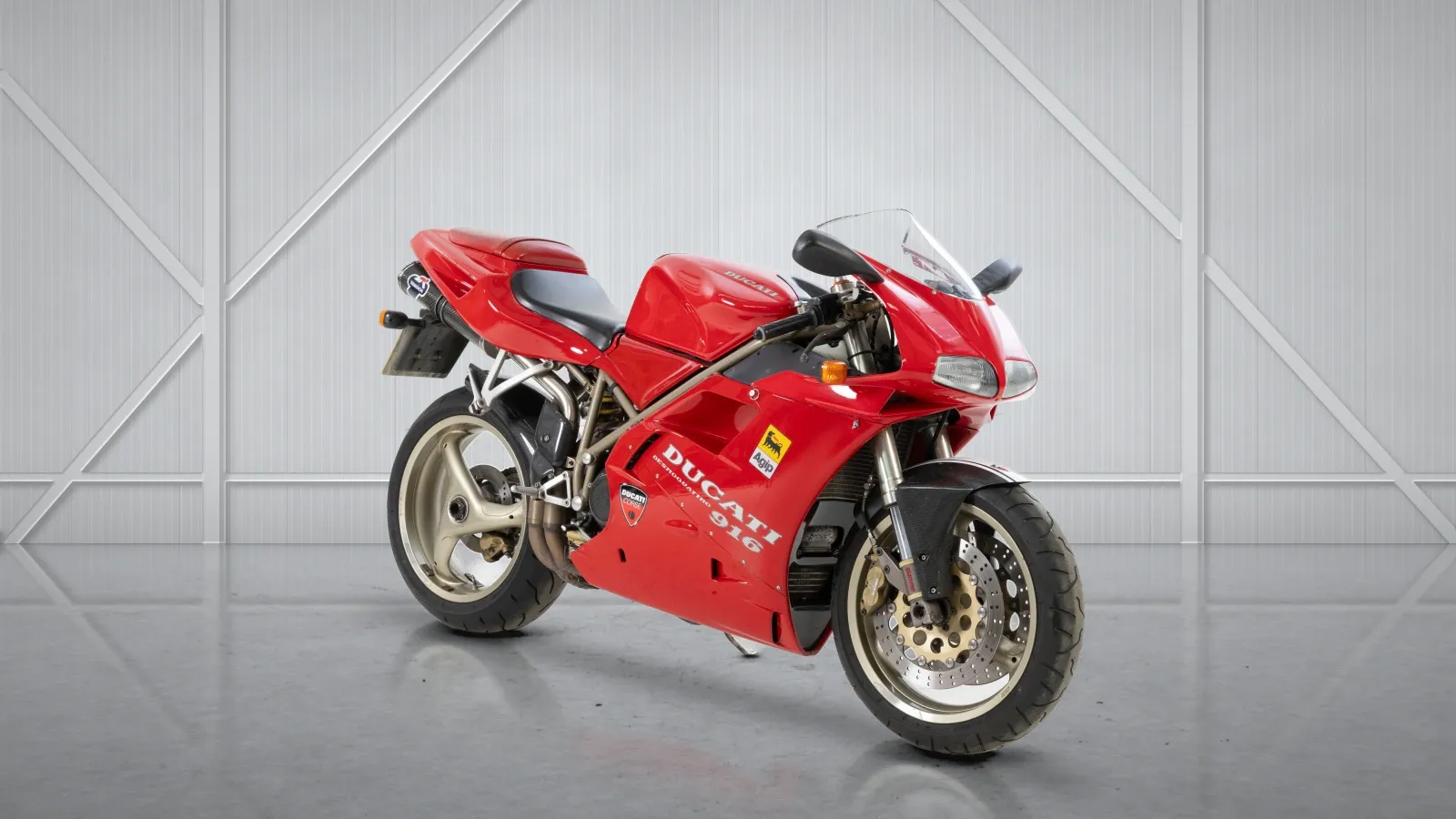
The Ducati 916 developed the 888's Desmoquattro engine concept into a redesigned superbike with a longer-stroke engine, compact chassis and single-sided swingarm.

The Ducati 888 Strada brought an 888 cc Desmoquattro to Ducati's standard road range in 1993, between the earlier 851 and the following 916.

The Ducati 916 and Aprilia RSV Mille shared an Italian V-twin superbike brief, but their engines, chassis and mechanical choices took different approaches.

The Ducati 916, 996 and 998 share familiar superbike styling, but their engines and model-year specifications reveal three different stages of development.