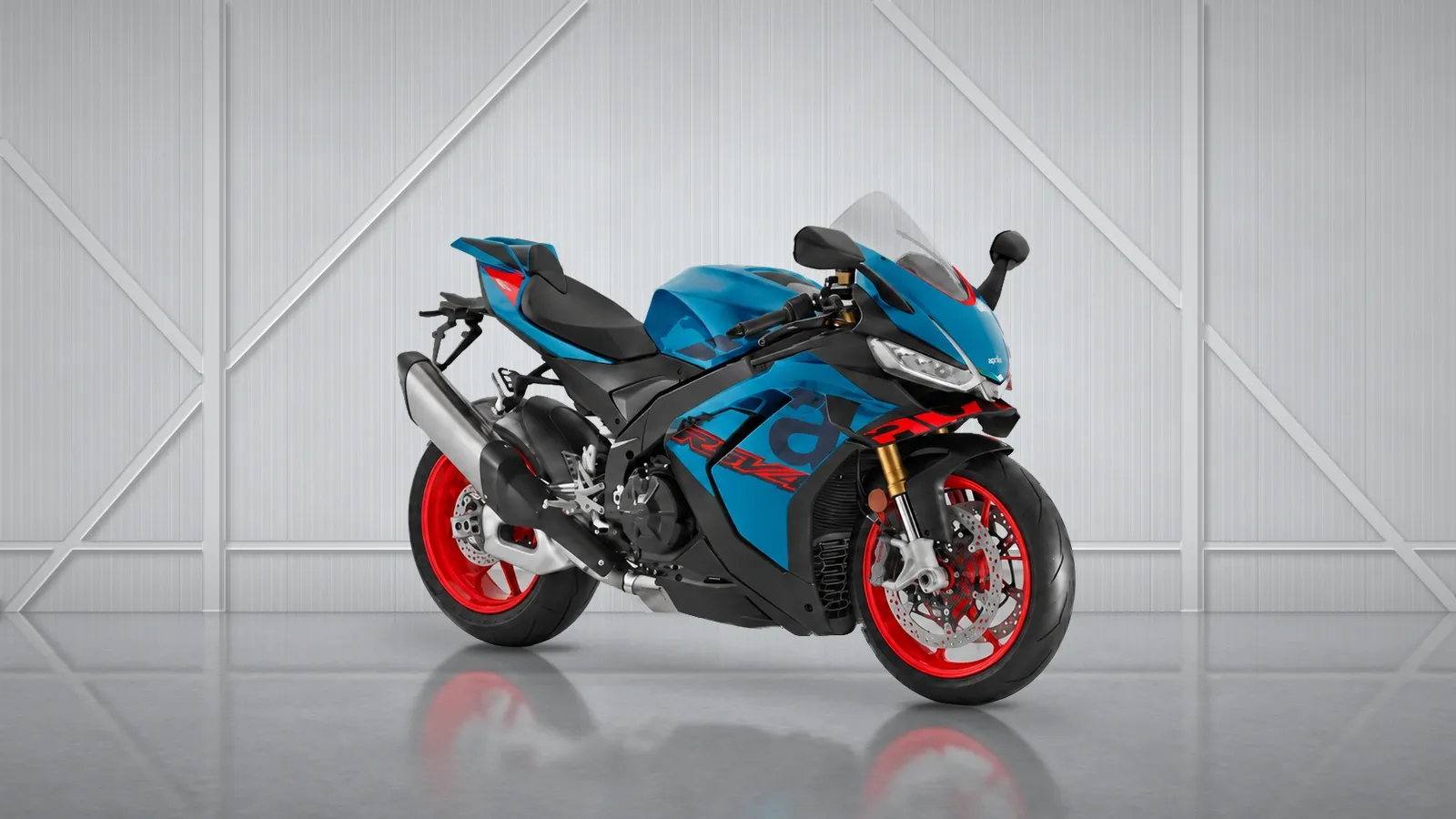
What is the Aprilia RS 660?
Aprilia unveiled the RS 660 at EICMA in November 2019 and put the road bike into production in 2020. The idea was straightforward: give a middleweight sports bike an aluminium twin-spar chassis, serious brakes and a level of electronics more familiar on bigger machines, then build it around a compact 659 cc parallel twin. The current standard UK/EU bike is the 105 hp Euro 5+ update introduced for 2025.
That standard bike sits alongside the RS 660 Factory rather than underneath its specification. Factory shares the 105 hp engine but changes the suspension and carries its own top-speed claim. The earlier Extrema, 35 kW restricted versions and Trofeo race bikes are different again, so their numbers only make sense when they stay attached to the right motorcycle.
As of 21 September 2026, Aprilia still lists the standard RS 660 in the UK. Its November 2025 range brochure carries the bike into the 2026 colour range in Blue Marlin and Venom Yellow, while the Factory is shown separately in Shakedown Yellow. That makes the current base bike easier to identify without pretending a colour alone proves its mechanical specification.
From 100 hp to the current 105 hp generation
The original road RS 660 arrived with 100 hp and 67 Nm. For the update unveiled in November 2024, Aprilia kept the 659 cc layout but enlarged the throttle bodies from 48 to 52 mm, revised the exhaust for Euro 5+ and raised output to 105 hp and 70 Nm. The extra five horsepower is only part of the change: Canariasenmoto found the revised engine fuller through the rev range and easier to keep flowing on a winding road without working the gearbox as hard.
The same update reshaped the fairing, integrated winglets beneath the screen, brought backlit switchgear and a revised 5-inch TFT display, and added launch control to the APRC package. Look beyond the paint and the generation becomes clearer: an earlier RS 660 can still look very similar, but it carries the 100 hp engine, smaller throttle bodies and the previous bodywork.
The 105 hp parallel twin and 230 km/h regulatory speed
The current engine is a liquid-cooled, forward-facing parallel twin with four valves per cylinder and Ride-by-Wire. Capacity is 659 cc from an 81 mm bore and 63.93 mm stroke, with Aprilia quoting 105 hp (77.2 kW) at 10,400 rpm and 70 Nm at 8,400 rpm. On the road, the useful bit is the spread rather than the headline alone: the current test bike pulled cleanly from lower revs and built speed progressively instead of demanding that the rider chase the top of the tacho.
Swiss type approval 6AA378 records 230 km/h for the current 77.2 kW RS 660 type and identifies both RS 660 and RS 660 Factory in its remarks. Aprilia separately claims 240 km/h for the Factory. That ten-kilometre-per-hour gap is a good reminder to check the version before repeating a performance figure: 240 km/h belongs to Factory, not the standard bike described here.
Drive goes through a six-speed gearbox and a wet multiplate slipper clutch. Aprilia Quick Shift is standard, so upshifts and downshifts can be made without using the clutch once the bike is moving.
Standard RS 660 versus RS 660 Factory
The standard and Factory share the 659 cc, 105 hp engine, aluminium frame, Brembo brake layout and 183 kg wet figure. The real hardware split starts with the suspension. The standard bike uses a 41 mm Kayaba upside-down fork with 120 mm of travel and a 130 mm Kayaba rear shock; both give the rider preload and rebound adjustment.
Factory moves to a fully adjustable 43 mm Öhlins fork and fully adjustable Öhlins rear shock, with the same 120 mm front and 130 mm rear travel. In practical terms, the base bike lets you set preload and control how quickly the suspension returns after a bump or braking load; the Öhlins setup also gives compression adjustment, so there is more scope to tune how the bike settles as the suspension is being loaded.
Both current versions use cast wheels in Aprilia's present technical table. That matters if you're checking a bike for originality: older specials and race-prepared RS 660s can wear different wheels and suspension, but those parts do not redefine the current road specification.
Aluminium chassis, Kayaba suspension and Brembo brakes
The current standard bike uses a twin-spar aluminium frame with the engine working as a structural member. Wheelbase is 1,370 mm and overall length 1,995 mm. Those dimensions do not tell you how a bike steers on their own, but the current Canariasenmoto test gives them some meaning: it found the Kayaba-equipped RS 660 light to turn, clear through the front end and settled in faster bends.
Braking comes from twin 320 mm floating front discs with Brembo radial callipers and a 220 mm rear disc, with steel-braided hoses as standard. Cornering ABS works with the six-axis inertial platform and includes three maps plus rear-wheel lift mitigation. Canariasenmoto described the front brake as powerful without being abrupt at the first touch, which is exactly the sort of distinction a specification table cannot show.
Aerodynamics and the APRC electronics package
The current fairing keeps the RS 660's double-layer side structure but adds a large wing beneath the windscreen and smaller integrated aerodynamic surfaces. Aprilia says the redesign was developed with CFD and wind-tunnel work to improve high-speed stability and manage airflow around the rider. Canariasenmoto's road test points in the same direction, reporting a firmer front end at speed and better control of hot air from the engine and radiator.
The standard bike's APRC package is unusually complete for a middleweight: six-axis IMU, engine maps, adjustable engine braking, traction and wheelie control, launch control, cruise control, bidirectional quick shift and multimap Cornering ABS, with five riding modes through the 5-inch TFT. The useful change for 2025 is not another acronym. Canariasenmoto found the traction control more transparent, the anti-wheelie gentler and the throttle response more progressive in the road modes, so the electronics interfere less obviously when the rider is trying to keep a clean rhythm.
Factory shares the same basic electronics architecture but differs in its standard equipment package. Aprilia MIA and other accessories can still change what is fitted to an individual bike, so the badge is only the starting point when you're checking a used example.
Wheels, tyres, fuel and 183 kg wet mass
Aprilia specifies cast 17-inch wheels, 3.5 inches wide at the front and 5.5 at the rear. Swiss approval data lists a 120/70 R17 front tyre and permits either 180/55 R17 or 180/60 R17 at the rear. Aprilia does not publish one tyre make and model across every market, so the homologated sizes are the reliable reference.
Fuel capacity is 15 litres and seat height is 820 mm. Aprilia's 183 kg figure is a wet mass under the EU 168/2013 basis, so it includes the bike's fluids, standard equipment and at least 90 per cent of usable fuel. That is the useful road-bike number. The much higher Swiss administrative unladen figure is measuring something different and should not be mistaken for the RS 660's wet weight.
What does the current RS 660 feel like on the road?
Canariasenmoto tested the full-power 105 hp standard bike in December 2025, and the picture is more useful than another list of specifications. The engine felt fuller and more progressive than before, especially when linking bends without constantly reaching for another gear. The electronics were less intrusive too, helping the bike rather than making their presence obvious every time the throttle was opened.
The chassis came through just as strongly. Steering was light, the front end gave clear feedback and the bike stayed composed through quicker corners, while the riding position remained sporty without folding the rider into a traditional supersport crouch. The test also found the revised bodywork useful at speed and better at moving engine heat away from the rider, which matters far more on an ordinary road day than a winglet drawing ever will.
AutoTrader reached a similar conclusion on the current base chassis in its 2026 UK review, praising the steering precision, KYB suspension, brakes and relatively manageable riding position. Because AutoTrader’s bike was A2-restricted, its steering, suspension, braking and ergonomics observations are useful here; its acceleration comments are not a guide to the full-power 105 hp bike.
Competition context without race-bike specifications
The RS 660's racing record is genuine. Aprilia reported a 2024 MotoAmerica Twins Cup title for the programme, and in 2026 an RS 660 won the Sportbike class at the Most round of the Superbike World Championship. That tells you the platform has been taken racing seriously; it does not turn the showroom bike into a WorldSBK homologation model.
A Trofeo or other race-prepared RS 660 can use different electronics, exhausts, suspension and a much lower competition weight. Those are the things needed for the job it is doing on circuit. They are not missing road-bike equipment, and they do not define the specification of the standard RS 660 you can register and ride on the road.
Buying and researching an RS 660
If you're looking at an RS 660, start with the production phase and exact version. The current standard bike combines the 105 hp engine, 52 mm throttle bodies, winged fairing, Kayaba suspension and five riding modes. Earlier road bikes belong to the 100 hp generation; Factory brings Öhlins suspension; Extrema is an earlier special with its own exhaust, carbon parts and weight figure.
The 35 kW version needs the same care. Its approval carries different power, torque and maximum-speed figures because it is legally restricted, not because the full-power RS 660 changed. Trofeo and track builds can also lose road equipment and gain race hardware, so compare like with like before deciding that a used bike is missing something.
For a used or nearly new RS 660, check the VIN and documents against the exact version, then look for a documented service history and confirm the suspension, road-registration equipment, software configuration, exhaust and ECU state. Aprilia's live UK configurator shows that the RS 660 is still listed. It cannot tell you whether a particular dealer has one in stock today or when a new bike can actually be delivered.