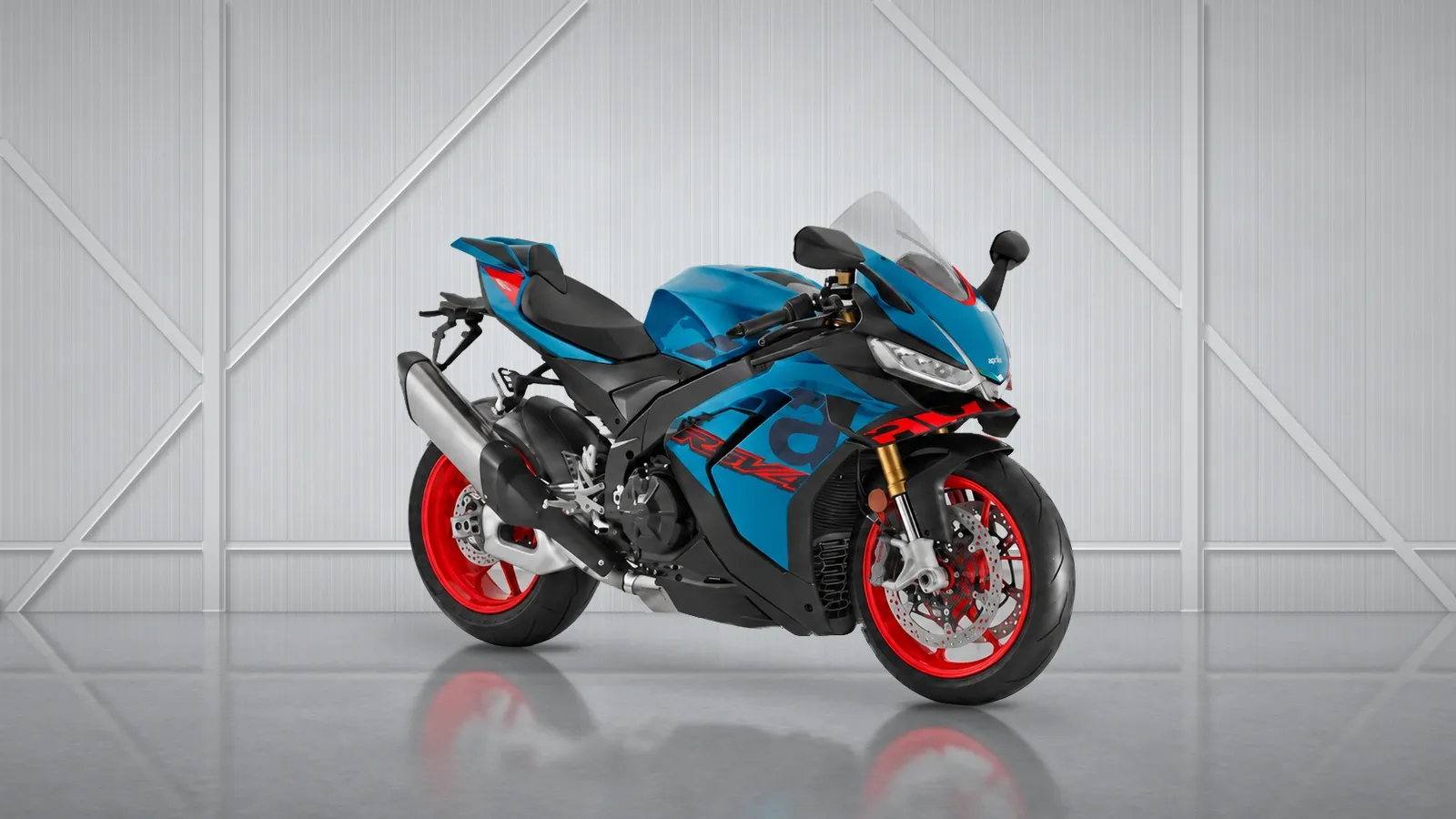
What is the Aprilia RSV Mille?
The Aprilia RSV Mille is where Aprilia stepped into the large-capacity superbike market in 1998. The simple part ends there, because the name covers several years of development. The figures here belong to the 1999 European base road motorcycle; the Mille R, limited Sport Production homologation model, factory race machines, later RSV 1000 and the RSV4 are separate subjects.
That distinction matters. By 2001 Aprilia was describing roughly 200 changes to the Mille family, and later manuals show different fuel capacity, dimensions and engine ratings from the early bike. Mix the generations and a perfectly correct figure quickly becomes wrong for the motorcycle you’re actually looking at.
Aprilia's own history dates the RSV Mille's launch to 1998. It records a new RSV 1000 in 2003 but gives no exact production-end date for the original Mille.
The 60-degree V-twin and who did what
Aprilia's July 1999 technical training material describes the RSV Mille engine as a new design conceived and developed by Aprilia engineers. It is a 60-degree longitudinal V-twin with four valves per cylinder, twin overhead camshafts, mixed chain-and-gear cam drive and twin-spark ignition. The period technical data gives 997.6 cc from a 97 mm bore and 67.5 mm stroke, with an 11.4 ± 0.5:1 compression ratio.
Rotax belongs in that story, but not as a substitute for Aprilia's own engineering role. Period Cycle World reporting identifies the engine as being built by Rotax in Austria, while Aprilia's training material assigns conception and development to its own engineers. The engine was developed by Aprilia and built by Rotax.
The narrow V-angle made the engine compact but created a vibration problem that a 90-degree twin largely avoids. Aprilia answered it with its AVDC system, using two countershafts. Dry-sump lubrication, an external oil tank and liquid cooling were part of the same compact package.
Injection, gearbox and the PPC clutch
The early RSV Mille used integrated electronic fuel injection and ignition. Aprilia specified 51 mm throttle bodies, a pressurised fuel circuit and a large airbox fed by forward-facing ducts, with the ECU also carrying self-diagnostic functions. The 1999 training material describes the original exhaust as a stainless-steel two-into-one system.
Transmission is a six-speed gearbox. For the 1999 base motorcycle Aprilia lists a 31/60 primary ratio, a 17/42 final ratio and individual gear pairs of 14/35, 16/28, 19/26, 22/24, 23/22 and 27/23. Final drive is by 525 sealed chain.
The wet multiplate clutch is hydraulically operated and uses Aprilia's PPC pneumatic assistance. Intake vacuum reduces clutch-spring loading on a closed throttle so the clutch can slip enough to reduce rear-wheel hop during aggressive deceleration. It is an era-appropriate mechanical/pneumatic solution, not a modern electronically controlled rider aid.
Aluminium chassis, suspension and brakes
The base RSV Mille uses an aluminium twin-beam frame made from cast and stamped sections, with an aluminium swingarm. Aprilia's 1999 technical data specifies a 25-degree steering-head angle, 97 mm of trail and a 1,415 mm wheelbase. The frame was developed with input from Aprilia's racing department.
At the front is a fully adjustable 43 mm Showa upside-down fork. One narrative page in the training course says 120 mm of movement, but Aprilia's dedicated fork specification and the technical-data table both give 127 mm for the base motorcycle. Rear-wheel travel is 135 mm through a linkage-operated adjustable monoshock.
Braking is by two 320 mm front discs with four-piston differential-bore calipers and a 220 mm rear disc with a two-piston caliper. Aprilia's training material describes the braking system as developed with Brembo. No ABS or traction-control system belongs to this 1999 base specification.
Wheels, tyres, fuel and two different mass figures
The manufacturer technical table gives 3.50 x 17 and 6.00 x 17 light-alloy wheels, with a 120/70 ZR17 front tyre and 190/50 ZR17 rear tyre; 180/55 ZR17 is listed as an alternative rear size. The 1998 press-launch motorcycle tested by Cycle World used Pirelli Dragon Corsa tyres with a 180/55 rear, so it does not establish the fitment for every early road bike.
Fuel capacity on the 1999 base specification is 20 litres including reserve, with a 4.5 ± 1 litre reserve. Later Mille material lists 18 litres.
Aprilia published two useful mass figures with different meanings. The training-course narrative gives a dry weight of 189 kg, while the technical-data table gives 221 kg 'ready for starting', explicitly including fluids and fuel. They describe different conditions: one without fluids, one ready to start.
What period testing found
Cycle World's November 1998 launch test used an actual production RSV Mille at Catalunya and on nearby public roads. Don Canet reported smooth shifting, strong and seamless midrange response, accurate fuel injection, high-speed stability and effective braking and PPC behaviour. The track portion was not a perfectly standard setup: the suspension had been adjusted for the circuit and the fork legs were raised 4 mm in the clamps.
A later April 2000 US test provides measured performance, but it is not a substitute for European factory specification. Cycle World recorded 111 rear-wheel horsepower, 67.6 lb-ft of torque and a 10.81-second quarter-mile at 129.4 mph on a motorcycle that had been fully derestricted by removing intake/exhaust restrictions and activating an alternate ECU map.
That market distinction is important. Cycle World separately reported that US bikes were sold in restricted form for noise and emissions compliance, while Piaggio's later historical material describes the Mille family as a 128 hp motorcycle. The two figures describe different markets and different measurement conditions.
Mille R and Sport Production are separate motorcycles
The R was the higher-spec road and track-oriented sister model, with equipment such as Öhlins suspension and lighter wheels appearing in period reporting. The standard motorcycle did not have them.
The RSV Mille Sport Production sits further away from the base bike. Period coverage describes only 150 examples built for homologation purposes, with a 995.6 cc engine using a 100 x 63.4 mm bore and stroke and substantial internal changes. Its output, geometry, bodywork and equipment were its own.
The factory race machines developed well beyond road specification.
World Superbike context without race-bike specifications
Aprilia took the RSV Mille family into World Superbike competition, and the programme produced a clear historical marker: Aprilia records Troy Corser's 2000 Phillip Island win on the RSV Mille as its first WorldSBK victory. The road family, homologation programme and production-derived racing were closely connected.
The distinction still matters. The SP existed to satisfy homologation needs, while factory race machinery developed beyond road specification.
The 2001 revision and the later RSV 1000 boundary
The first-generation Mille was materially revised during its life. Cycle World described Aprilia as making roughly 200 changes for 2001, including a reshaped resin fuel tank, altered bodywork, revised rider position and aerodynamic changes. Factory service material for later bikes also shows a move from 20 to 18 litres of fuel capacity, altered external dimensions and different rated-output entries.
Aprilia's corporate history says a new RSV 1000 was launched in 2003. Period 2003 testing already describes the outgoing Mille as the old generation and the replacement as the RSV 1000 R/Factory family. Aprilia has not published an exact production-end date for the original Mille.
Buying and researching an original RSV Mille
If you’re looking at an original Mille, identity comes first. Establish the year and whether the bike is a base RSV Mille, Mille R, Sport Production or later RSV 1000 before you trust a figure from a manual, advert or parts catalogue. Suspension, wheels, fuel capacity, brakes and bodywork changed across the family, and an SP or R specification can make a standard bike look incorrectly modified when the real problem is simply the wrong source.
For an early base motorcycle, period Aprilia documentation is far more useful than an undated specification list. The 1999 manual and technical course give the 20-litre tank, Showa fork, wheel sizes, gearbox ratios and both mass figures. Later documents aren’t corrections to the early bike; they belong to later production phases and should be matched to the actual model year.
Condition, service history, recalls, parts availability and current ownership support are separate questions from original specification. Aprilia provides current maintenance, recall, parts and dealer-support channels for the marque, but an individual RSV Mille still needs to be assessed by year, condition and configuration. Owner anecdotes do not support a blanket reliability verdict. Used prices vary by year, condition and configuration.